
Malkan Machinery's Southeast Expansion: Form Ironing Presses and Anatolian Investments
By 2014, government incentives had begun to bear fruit in Anatolia. Investments in the region increased the number of garment factories, and these plants began to produce high-quality work. As the investment wave spread toward the southeast, jacket and trouser manufacturers were looking for a reliable local partner for their pressing departments.
Through its investments during the ten years leading up to 2014, Malkan Machinery helped jacket and trouser manufacturers earn profits, sew quality products and reduce foreign currency outflows. Form ironing presses, once supplied largely from abroad, were now produced in Malkan Machinery's own facilities and offered to domestic and foreign markets.
In its R&D work with customers, Malkan Machinery brought current technology into the product. The aim was to make the manufacturer's job easier and to help finish the product at the highest quality. These projects, carried out in new factories built with government incentives, allowed the company to put its signature on successful work in the region.
Some of these projects are Terkonsan Tekstil, Ak Konfeksiyon and Yenipinar Konfeksiyon in Kahramanmaras; Taskinirmak (Imza Giyim) and Aytek Pantolonlari in Adana; and the LC Waikiki facilities in Malatya. Besides the views of company owners, this article also covers the technical framework of form ironing presses.
The sections that follow cover the working principle of form ironing presses, buck and form compatibility, PLC program management, pressing department planning in new plants and the most common pressing defects. The aim is to give every manufacturer planning a pressing investment a concrete and practical roadmap.
1. GOVERNMENT INCENTIVES AND THE GROWTH OF GARMENT INVESTMENTS IN ANATOLIA
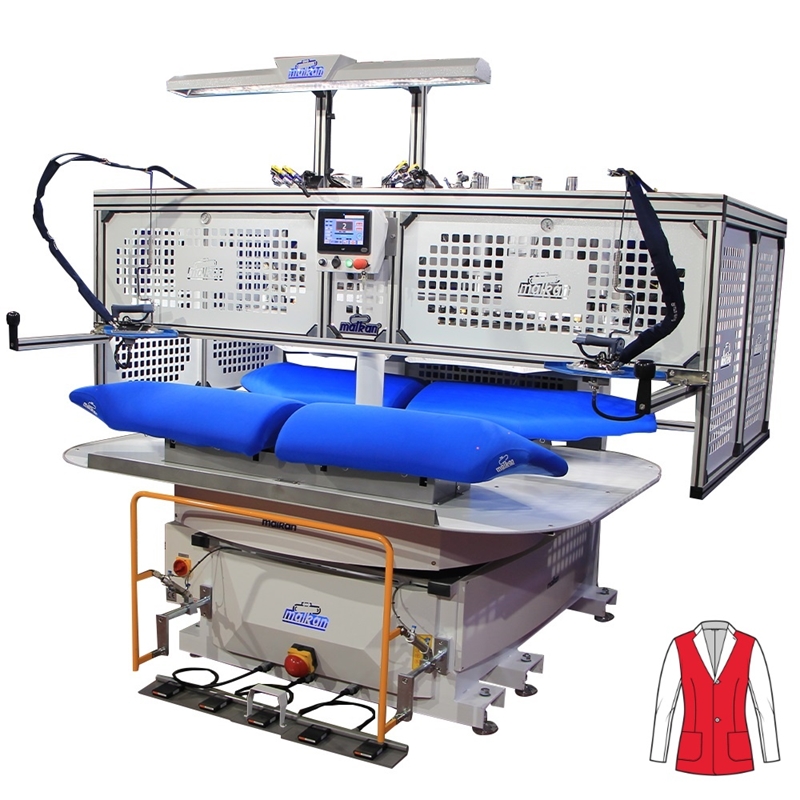
A press application from a jacket and trouser pressing department.
The Decision on State Aid for Investments (No. 2012/3305), published in the Official Gazette on June 19, 2012, divided the provinces into six regions by socio-economic development level. The system consisted of general, regional, large-scale and strategic investment incentives. To benefit, a project had to be approved and an incentive certificate issued.
Regional supports were designed to grow stronger toward less developed regions. For the labor-intensive garment sector, this structure made building new factories in Anatolian cities attractive. Kahramanmaras, Adana and Malatya, all with strong textile traditions, saw new garment investments in this period.
Geographically, Kahramanmaras and Adana lie in the Mediterranean Region, while Malatya is in the Eastern Anatolia Region. The phrase "Southeast expansion" in this article describes the investments made in these industrial cities along the line extending toward Southeastern Anatolia. The factories built here contributed directly to employment and export capacity in the region.
In a newly built garment factory, the pressing department determines the success of the investment as much as the sewing line does.
Because the final look of a jacket or trousers emerges at the press, form ironing presses ranked among the most critical items on these factories' machine lists. In an incentive-backed investment, choosing the right form ironing presses helps turn the support into long-term returns.
2. What Are Form Ironing Presses and How Do They Work?
Form ironing presses are machines that press a specific area of a garment between lower and upper bucks matching the anatomical shape of that area.
The buck carries the target form of regions such as the shoulder, collar, front or sleeve. The fabric is shaped on this buck with steam, pressure and vacuum, and the form is then set permanently.
The working cycle of form ironing presses generally consists of four steps. In the first step, steam is applied and the fibers gain flexibility through moisture and heat. In the second step the upper buck closes and applies pressure, and in the third step the vacuum draws moisture and heat out of the fabric.
The last step, cooling and setting, determines how long the form lasts. Fibers such as wool take shape when hot and moist, and keep that shape once they cool and dry. For this reason, form ironing presses are designed as integrated systems that do not merely heat, but also remove moisture to fix the form.
Each step of the cycle is defined by time. Steam, pressure and vacuum times are adjusted to the fabric weight, fiber content and interlining structure.
The values vary by manufacturer, model and fabric, and are verified with a trial pressing. Correctly adjusted form ironing presses reduce dependence on operator skill and finish every product to the same standard.
The quality of the steam matters as much as the time. Wet steam leaves water spots and uneven moisture on the fabric, while dry saturated steam spreads evenly between the fibers. The temperature of saturated steam depends on its pressure, a relationship that follows the laws of thermodynamics.
For this reason, form ironing presses need an installation fed with dry steam at a suitable pressure, with condensate drained regularly.
3. BUCKS AND FORM COMPATIBILITY IN JACKETS AND TROUSERS

A view from the pressing department for buck and form compatibility.
In the words of Terkonsan Tekstil owner Ihsan Kurtar, jacket making is buck making.
Every model, size range and cut line requires a different form, and a mismatch between the buck and the product can spoil work done carefully on the sewing line during final pressing. For this reason, Malkan Machinery designs press bucks according to the customer's product.
In final pressing of a jacket, form ironing presses work as stations divided into regions such as the front, shoulder, collar and sleeve.
The buck of each station carries the three-dimensional shape of that region, and the operator places the product on this shape. The flow between stations is planned in a sequence where the form given in one region is not disturbed in another.
On trousers, form ironing presses work at the waist, hip and hem. A straight, single-line crease at the hem, a waistband that sits without waviness and a hip form that holds its shape decide how trousers look on the shelf and in the shop window.
In trouser lines, buck selection depends on the cut type and the elasticity of the fabric.
Buck covering is also part of form compatibility. In the sector, materials such as sponge, silicone and fabric are used in the covering layers; these layers spread the pressure and help steam and vacuum reach the fabric evenly. Because a worn covering can leave shine and marks, it is checked regularly and renewed when necessary.
Bucks and coverings are also evaluated according to fabric type. Wool suiting, polyester blends and elastane-containing trouser fabrics react differently to heat, pressure and moisture. For this reason, form ironing presses give the best results not with a single setting but with buck and program combinations prepared for each fabric.
4. PROGRAM MANAGEMENT IN FULLY AUTOMATIC PLC PRESSES
Ihsan Kurtar says they saw performance beyond their expectations from fully automatic form ironing presses with PLC. A PLC, or programmable logic controller, manages the press's steam, pressure, vacuum and buck movements in predefined sequences and times. As a result, the same product is pressed with the same cycle even when the shift or operator changes.
PLC-equipped form ironing presses can store a separate program for each model and fabric. When the product changes, the operator selects the relevant program, and the steam, pressure and vacuum times are applied automatically. This structure reduces the risk of error in production plans with many models that change frequently.
The basic principle of program management on form ironing presses is to record the values verified by trial pressing. When a new fabric arrives, times are first tried on sample pieces, and form, shine and marks are checked. The approved program is then transferred to production, a discipline that also reduces returns from the quality control department.
Taskinirmak (Imza Giyim) owner Ismail Taskinirmak also lists the programming technique among his reasons for choosing Malkan Machinery. A program structure that is practical to use and easy to adapt to different fabrics shortens operator training time in newly built factories. In this way, form ironing presses make it easier to reach consistent quality even with new teams.
5. WHAT LOCAL MANUFACTURING GIVES THE INVESTOR

Planning the pressing department in new plants.
Local manufacturing means more than a price advantage in an investment in form ironing presses. When the manufacturer and the user speak the same language, work in the same time zone and can reach the factory quickly, every step from buck adaptation to service speeds up.
Garment company owner Ali Riza Kalay sums up this expectation as a search for a partner that “understands us, knows what we want and produces to suit us.”
Imported form ironing presses can require long lead times for spare parts and service. With local manufacturing, access to spare parts and the technical team is more direct, which reduces downtime and the workload that piles up on the line. This is why it is meaningful that Ismail Taskinirmak specifically mentions after-sales service speed among his reasons.
Using local machinery also has macroeconomic consequences. Foreign currency earned through exports stays in the country instead of going to imported machinery, and it funds R&D and capacity investments of the domestic machinery industry. The pride Ali Riza Kalay feels that a local company makes products at this technological level reflects the same view.
Buck customization is another strength of local manufacturing. When a product-specific buck is designed and produced by the same team, the trial, correction and delivery cycle becomes shorter.
With the experience it has accumulated since 1971, Malkan Machinery adapts and delivers form ironing presses and bucks to suit the customer's product. Today, Malkan Machinery also works in a strategic partnership with Indupress in press technology.
6. INVESTOR VIEWS FROM KAHRAMANMARAS AND ADANA
The people who made these investments describe Malkan Machinery's work in the region best. The views below were collected in 2014; company ages and years of cooperation are as of that date.
Terkonsan Tekstil owner Ihsan Kurtar:
“I chose Malkan Machinery because pressing systems are extremely important in our business; we can say they are the makeup of the suits we sew. That is why we have worked with Malkan Machinery for 20 years. Our research also showed us that we had to choose Malkan Machinery.”
“We had our ironing presses, tables and utility work done by Malkan Machinery, and we are very satisfied.”
“Jacket making is buck making; they made bucks to suit our jackets, and with fully automatic PLC presses we saw performance beyond what we expected. As a result, we bought the systems for our newly established trouser production from Malkan Machinery as well.”
“The results I got from the work and the advanced-technology products I bought at a fair price led me to choose Malkan Machinery. I am also very satisfied with my choice.”
Garment company owner Ali Riza Kalay:
“I chose Malkan Machinery. We are an 18-year-old company; so far we have always worked with our own capital and intend to continue that way. We earn our money with difficulty, and we have to behave accordingly when we spend it.”
“When renewing our pressing line, the features we wanted were clear: top-level pressing quality, a price in proportion to quality, and a company that understands us, knows what we want and produces to suit us. We saw that Malkan Machinery met these expectations best.”
“That our colleagues in Maras also chose Malkan Machinery at that time showed us we had made the right choice. I would also like to say that we are proud of a local company making products this technological.”
Taskinirmak (Imza) Giyim owner Ismail Taskinirmak:
“The main reason we chose Malkan Machinery is that it is a local company and meets all our technological requests as we wish and on time.”
“When your partner serves you without problems, that naturally shows in the quality of your work. We are pleased that we can solve the needs of our machine park easily with Malkan Machinery.”
“Another reason we chose Malkan Machinery was our comparisons with European manufacturers. In these reviews we saw that Malkan Machinery met our expectations in bucks, models and programming technique, and that it is also strong in capacity.”
“In addition, its reputation since 1971, being a partner that inspires confidence, and its after-sales service speed were decisive in our choice of Malkan Machinery.”
7. PRESSING DEPARTMENT AND UTILITY PLANNING IN NEW PLANTS

A pressing department made up of presses, tables and utilities.
The fact that Terkonsan Tekstil had its tables and utility installations done by Malkan Machinery, in addition to its ironing presses, shows that a pressing department must be planned as a whole.
Form ironing presses deliver full efficiency only with properly sized steam, vacuum, compressed air and electrical infrastructure. When this infrastructure is handled together with the building project in new factories, costly changes later on are avoided.
On the steam side, the first step is a capacity calculation based on the simultaneous consumption of all form ironing presses and tables. The choice of steam boiler or steam generator is evaluated together with pipe lengths, insulation and condensate drainage.
The safe operation of steam boilers is also an integral part of this planning. When steam traps and drain points are placed correctly, dry steam reaches the presses and the risk of water spots drops.
On the vacuum side, the choice is between a central system and individual vacuum on each machine. A central vacuum feeds many stations from a single source but requires pipe design and a pressure-loss calculation, while an individual solution offers flexibility in layout. The choice depends on line size, layout and the company's growth plan.
Compressed air feeds the pneumatic system that drives the press bucks. Dry and clean air extends the life of valves and cylinders, so the dryer and filter are an integral part of the installation. For form ironing presses, the air line is sized so that pressure does not drop when all stations work at the same time.
In the layout plan, the pressing department is placed close to the exit of the sewing line and the quality control area. The shorter the distance products travel between departments, the lower both the time loss and the risk of a pressed product wrinkling again.
During commissioning, form ironing presses are tested, programs are loaded and operators are trained on their own products. A pressing department made up of presses, tables and utilities can also be arranged as a turnkey finishing line.
8. COMMON PRESSING DEFECTS AND PRESS-SIDE SOLUTIONS
Shine is the most common defect, especially on dark wool fabrics. Excessive temperature, too much pressure or a worn buck covering crushes the fiber surface and makes it reflect light differently. The solution is to lower the pressure and time in the program to suit the fabric and to renew the covering when necessary.
Seam and edge marks occur when the seam allowance or pocket bag beneath the fabric shows through to the surface. A buck covering with enough flexibility and a pressure suited to the fabric prevent this mark. In companies working with form ironing presses, a product-specific buck is the lasting solution to this problem.
Water spots and uneven moisture mostly come from wet steam or insufficient vacuum. Checking condensate drainage, insulating the steam line and measuring vacuum performance regularly remove this defect. When the vacuum time is kept short, the product stays damp and loses its form quickly.
Loss of form means the product loses its shape on the hanger after a few hours. Insufficient cooling and a short vacuum time prevent the fiber from fixing its new form. PLC-equipped form ironing presses link these steps to the program and provide consistency independent of the operator.
Waviness and wrinkling appear especially on trouser fabrics containing elastane and where interlining is incompatible. Because the fabric and the interlining react differently to heat, waves can form on the surface; correct interlining selection and a low-temperature program reduce this risk. Keeping a defect log and updating the program accordingly is the most effective way of continuous improvement.
9. MAINTENANCE AND OPERATOR TRAINING FOR LONG SERVICE LIFE

The result of the form given by the press on the product.
Form ironing presses need planned maintenance to deliver the same quality for years. Daily checks cover steam and air leaks, the condition of the buck covering and vacuum suction. Weekly and monthly maintenance covers steam traps, filters, valves and sealing elements.
The temperature and pressure values of heated bucks are measured at regular intervals and compared with the values in the program. A deviation shows up as shine or insufficient form on the fabric, while a deviation noticed early can be fixed with a small adjustment. Recording measurement results bases the maintenance plan on data rather than guesswork.
Operator training is the invisible but decisive item of the investment. The operator's ability to place the product on the buck correctly, select the right program and spot a defect immediately directly affects quality. In new factories, this training should be given on the operators' own products during commissioning.
Occupational safety is as important as maintenance. Because of hot surfaces, steam and moving bucks, the press guards and safety devices such as two-hand control, where fitted, must never be disabled. With regular maintenance and training, form ironing presses keep the same standard in the years after the first day of the investment.
10. CONCLUSION
In 2014, as garment investments in Anatolia gained strength with government incentives, a local partner came to the fore in the pressing department.
Jacket and trouser manufacturers in Kahramanmaras, Adana and Malatya worked with Malkan Machinery for form ironing presses, bucks and utility needs. The company owners' views highlight buck compatibility, programming, the balance of price and quality, and service speed as reasons for their choice.
In 2014, when the news was published, the garment sector was expected to keep growing under government incentives, and the investments in Anatolia pointed the same way. In this growth, well-chosen form ironing presses turn the effort put in at the sewing line into value at final pressing.
Malkan Machinery stands by manufacturers on this journey with its experience since 1971 and an export network reaching 95 countries.
Developments in garment production automation also shape how investments in pressing departments are planned. For the company's current strategy, you can browse the Malkan Vision 2025-2026 page.
11. Frequently Asked Questions (FAQ)
What products are form ironing presses used for? They are mainly used in final pressing of products that need form, such as jackets, suits and trousers. Each station presses a specific area, such as the shoulder, collar, front, sleeve, waist or hem, with its own buck.
What do PLC-equipped form ironing presses give the operator? A PLC applies steam, pressure and vacuum times through a stored program for each product. The operator only selects the right program, so the product is finished to the same standard even when the shift changes.
Why is a product-specific buck important for form ironing presses? The buck carries the target form of the product. An incompatible buck can spoil work done on the sewing line and leave marks and shine, while a product-specific buck gives the right form and lets craftsmanship stand out.
Where should pressing department planning start in a new plant? After the product range and target capacity are set, the list of presses and tables is drawn up. Steam, vacuum, compressed air and electrical infrastructure are then sized together with the building project.
Why do water spots occur in pressing? Water spots mostly come from wet steam or insufficient vacuum. Checking condensate drainage, line insulation and a sufficient vacuum time prevents the problem.
What maintenance do form ironing presses need? Steam and air leaks, buck coverings and vacuum suction are checked daily. Steam traps, filters and valves are reviewed in periodic maintenance, and temperature and pressure values are compared with the program.
Plan Your Pressing Department with Form Ironing Presses
Let us plan your new plant's pressing department or the renewal of your existing line together: with product-specific bucks, a PLC program structure and turnkey utilities, turn your investment in form ironing presses into lasting value. Talk to the Malkan Machinery technical team today.
Talk to Our Technical Team →Follow us on social media:
Resources and Detailed Information
- • Wikipedia – Programmable logic controller – General definition and working principle of programmable logic controllers https://en.wikipedia.org/wiki/Programmable_logic_controller
- • Wikipedia – Steam – General definition and types of steam https://en.wikipedia.org/wiki/Steam
- • Condensate Return – Detailed page on condensate drainage and return https://malkan.com.tr/en/condensate-return/
- • Jacket Pressing Bucks – Detailed page on jacket pressing bucks https://malkan.com.tr/en/jacket-pressing-bucks/
- • Industrial Steam Boiler Safety – Detailed page on safe operation of steam boilers https://malkan.com.tr/en/industrial-steam-boiler-safety/
- • Garment Finishing Technology 2026 Guide – Detailed page on garment finishing and production automation https://malkan.com.tr/en/garment-finishing-technology-2026-guide/
- • Turnkey Finishing Line – Information page on turnkey finishing lines https://malkan.com.tr/en/turnkey-finishing-line/
- • Indupress Machines – Detailed page on Indupress machines https://malkan.com.tr/en/indupress-machines-german-ironing/
- • Malkan Vision 2025-2026 – Corporate vision and strategy page https://malkan.com.tr/en/malkan-vision-2025-2026/