
Canvas Shaping Press and Bench: A Jacket’s Stance Begins at the Front Panel
A canvas shaping press is used in canvas shaping, where the jacket-front canvas is given its form, and in hair canvas fusing, where hair canvas is bonded to the front panel. In Malkan Machinery’s product range, this equipment sits in the “Canvas Shaping and Hair Canvas Fusing” category, among the jacket intermediate pressing machines and benches.
The fullness of a jacket’s chest, the elegance of its lapel roll and the smoothness of its front panel are largely determined at this stage. If the front panel does not take the correct form here, the jacket cannot achieve the same stance, however much care is given to final pressing.
A well-chosen canvas shaping press is part of a system that leaves jacket quality nothing to chance. When the front panel is shaped with the same care every time, the brand achieves the same stance in every jacket.
This guide was prepared by Malkan Machinery Corporate Communications for jacket manufacturers, production managers and technical teams. It covers two products that represent two different approaches: the centrally vacuumed UP10A11AT canvas shaping and hair canvas fusing ironing bench and the rotary-table KAR10A11A carousel canvas shaping and hair canvas fusing ironing press.
At the end of the guide, you will find a seven-point checklist you can use when choosing the canvas shaping solution that suits your plant.
What Is Canvas Shaping? Its Place in Jacket Production

In classic jacket production, the front panel is the most important part, as it defines the character of the jacket. The canvas placed inside the front panel acts as an invisible skeleton that carries the fullness of the chest and the stance of the lapel.
Canvas shaping, called sadafodra in Türkiye, is the process in which the canvas in the jacket front is shaped to the form of the chest and lapel. Hair canvas fusing is a separate process; the hair canvas is placed on the front panel over a curved form and bonded with steam, heat and pressure.
The two processes complement each other but do not replace each other. In Malkan Machinery’s product range, the two processes are listed in the same category but under separate names: canvas shaping and hair canvas fusing. When choosing a canvas shaping press, it should be clear from the start which of these processes, or both, is the target.
Both processes are intermediate pressing operations. In other words, they are carried out within the sewing process before the garment is finished, preparing a front panel that carries the correct form into the following sewing stages.
The canvas shaping press and bench make this stage far more consistent and faster than manual ironing. Processing the front panel on the same buck with the same settings every time ensures that jackets share an identical stance.
Hair Canvas: The Hidden Skeleton of the Jacket
Hair canvas is a special type of interlining used in the lapel and chest areas of garments such as jackets, coats and overcoats, giving these areas firmness and smoothness. The flexible, self-recovering structure of hair yarn helps the jacket keep its form for a long time.
Hair canvas production has deep roots in Türkiye. Tosya hair canvas, produced with traditional methods in the Tosya district of Kastamonu, is a product registered as a geographical indication.
Correct placement of the hair canvas on the front panel directly determines the quality of the jacket. When the canvas slips against the front panel, wrinkles or is not fixed sufficiently, waviness and irregularity appear in the chest area of the jacket.
That is why the canvas shaping and hair canvas fusing stages aim for the canvas and the front panel to meet in the correct alignment, at the correct tension and in the correct form. A canvas shaping press or bench makes this meeting controlled and repeatable.
A canvas shaping press therefore considers the hair canvas and the front panel together. A setting that does not suit either of them affects the entire result.
Why Does Intermediate Pressing Matter So Much?
In jacket production, pressing is not only an operation carried out at the very end. Intermediate pressing at different stages of the sewing process ensures that each part enters the next operation in the correct form.
The operation carried out with a canvas shaping press is one of the most critical of these intermediate pressing steps. The form given to the front panel at this stage determines the final stance of the jacket and sets the limits of the corrections that can be made in final pressing.
Doing intermediate pressing correctly also lightens the load on final pressing. A front panel whose form has been set correctly from the start reaches the desired appearance in final pressing in less time and with less intervention.
The correct form built in the front panel also makes the work done in final pressing with jacket pressing bucks and finishing equipment such as a tunnel finishing system easier.
For this reason, a canvas shaping press investment is not just a machine investment but a quality investment that extends across the entire jacket production chain.
Bench or Press? Two Different Approaches

There are essentially two approaches when choosing a canvas shaping press and bench: vacuum benches, where the operator works with a hand iron, and presses that carry out most of the operation under program control.
Vacuum benches offer the operator flexibility. Switching between different models and small batches is quick; the operator’s skill is an important part of the result.
A programmable canvas shaping press, on the other hand, provides consistency and capacity in high-volume production. Because settings are stored in the program, the result varies less from operator to operator.
Malkan Machinery’s product range includes solutions that represent these two approaches. The UP10A11AT is a centrally vacuumed canvas shaping and hair canvas fusing ironing bench; the KAR10A11A is a programmable carousel canvas shaping press with a rotary table.
The same category also includes the KAR10A11AS carousel canvas shaping and hair canvas fusing ironing press, with two lower bucks and a 120-degree rotary table. The UPP10A11AEL, meanwhile, is a right-left single-unit canvas shaping and hair canvas fusing ironing press whose elevator-type buck arrangement saves floor space and speeds up work placement.
Whether to choose a canvas shaping press or a bench depends on production volume, model variety, the number of operators and the plant’s infrastructure. The following sections of the guide look at the two solutions separately to make this decision easier.
UP10A11AT: Centrally Vacuumed Canvas Shaping Bench
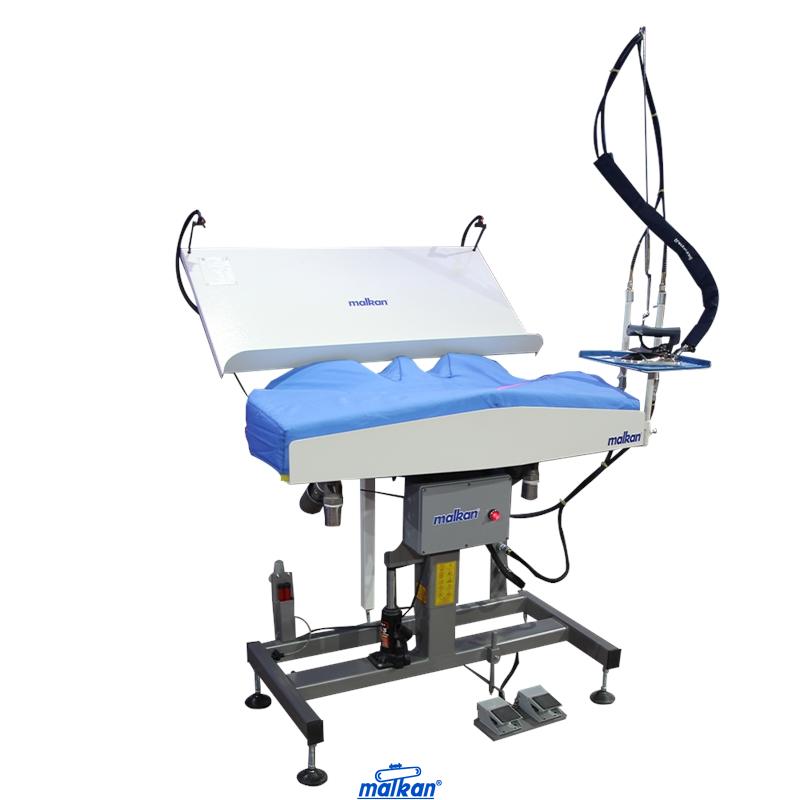
The UP10A11AT is a centrally vacuumed ironing bench with an aluminum buck suitable for fusing curved hair canvas to jacket front panels. The bench allows separate vacuum operation for the right and left front panels.
The buck has vacuum channels for the lapel roll line while hair canvas is being fused on it. These channels help keep the lapel roll area in the correct form during the operation.
For accurate placement, there are two line laser markers, one on the right and one on the left. The laser lines make it easier to position the front panel and the canvas in the same place every time.
The working height of the bench can be adjusted with a jack. This feature allows operators of different heights to work in a natural posture.
The steam coil system supports fast heating of the buck and energy savings. The pneumatic vacuum pedal requires no electrical connection; the vacuum exhaust is made entirely of chrome-nickel stainless steel.
The bench has a movable work placement stand and a movable, heat-resistant iron rest. A direct-steam seam-opening hand iron and an aluminum-framed iron pad also come with the bench.
The UP10A11AT is built to CE European safety standards, with a robust profile-frame construction and first-class covering materials. The bench operates with central steam, vacuum and air.
Although not as automated as a carousel canvas shaping press, the bench delivers strong and flexible results in the hands of an experienced operator.
KAR10A11A: Carousel Canvas Shaping Press with Rotary Table
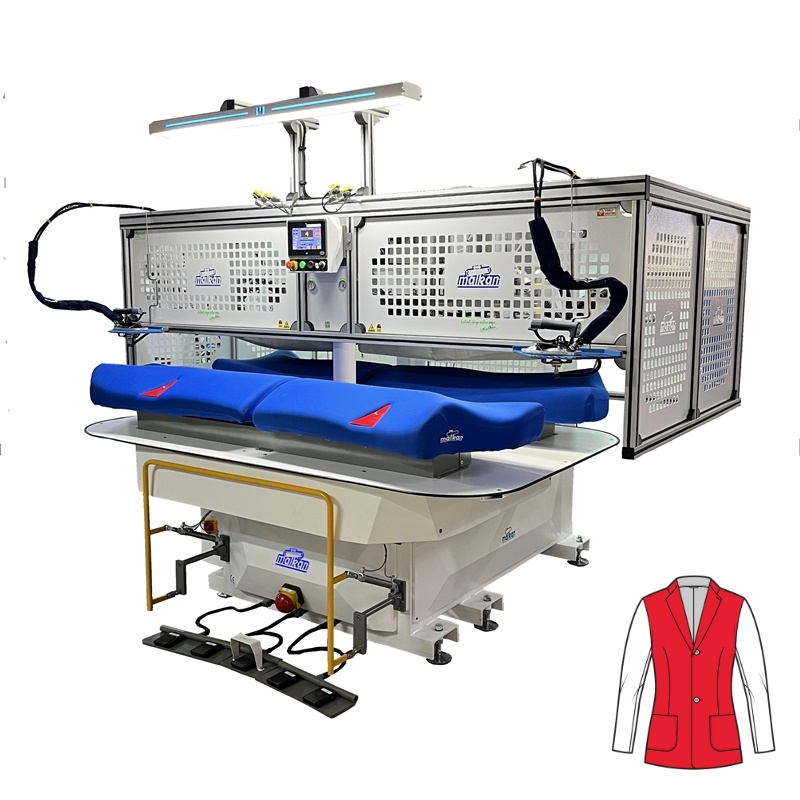
The KAR10A11A is a carousel canvas shaping and hair canvas fusing ironing press with a rotary table carrying four lower bucks. Suitable for operation by one or two operators, it is aimed at plants targeting high production capacity.
The most important advantage of the rotary table design is that loading and pressing do not wait for each other. While the operator places a new piece on one buck, the operations on the other bucks continue.
The press is PLC-controlled and managed through a seven-inch color touchscreen. More than one hundred different pressing programs can be defined on the screen, and programs can be copied.
English and the national language of Türkiye are the standard programming languages, with twelve language options available. This feature makes operation easier for plants working with multinational teams.
Press pressure is set digitally and controlled on the screen with 0.1 bar precision. Distance control and gap adjustment are carried out digitally with a magnetic scale.
Two spot lasers per buck help place the piece quickly and accurately. Powerful LED lighting allows the operator to see the working area clearly.
This design makes the KAR10A11A a canvas shaping press built for high-volume production.
Steam, Vacuum and Pressing Functions on the KAR10A11A
For a canvas shaping press, steam and vacuum control is the foundation of quality. On the KAR10A11A, upper buck steam can be programmed in stages, and there is also lower buck steam. Lower buck vacuum can be programmed in stages, and upper vacuum is also available.
The upper bucks have a perimeter vacuum system. Pedal-controlled and programmable lower blowing makes it easier for the piece to settle on the buck.
Rotation vacuum and final vacuum can also be programmed in stages. These settings help the piece fix its form before it is removed from the buck.
The pat-pat function allows pressing with a gentle patting action. This function supports shaping delicate areas without applying hard pressure to the fabric.
For touch-ups, there are two hand irons and iron rests equipped with safety features. Vacuum or blowing can be activated at the functional hand iron rest.
The bucks have a steam coil system and insulation; this design supports fast heating and energy savings. Advanced CNC surface machining is used in buck design.
Quality, Safety and Monitoring on the KAR10A11A
Automatic cover calibration on the KAR10A11A helps keep pressing quality consistently high. The pressed-piece counter and cover-time warning make it easier to track when covers need replacing.
The fault-warning diagnostics and logging feature helps locate faults quickly. Manual function control is also possible from the touchscreen.
A program lock key prevents unauthorized changes to programs. This feature is important for protecting correctly set recipes.
Upper bucks with a mechanical locking system support safe operation and long cover life. A rotary table safety barrier is fitted for operator safety.
The press has Ethernet, RS232C and RS422/485 communication ports and one USB 2.0 input. The USB input allows programs to be transferred to a desktop computer.
The MALKAN ONLINE remote access and monitoring system and recipe recall by barcode or QR code are offered as options. The quick-start option helps increase daily production capacity.
These monitoring features help a canvas shaping press investment operate at the same quality for many years.
The KAR10A11A operates with central steam, vacuum, air and 220 V electricity.
From Feature to Benefit: How Technical Details Affect Production
Technical feature lists are valuable; the real question, however, is what these features change in production. Most features of a canvas shaping press or bench serve three core gains: consistency, speed and safety.
Laser markers are the first step towards consistency. Placing the front panel and the canvas in the same position every time supports symmetry between the right and left front panels and an identical stance across jackets.
Programmable steam and vacuum are the second step towards consistency. A program saved for each model prevents settings from varying between operators and ensures the correct result is repeated on every shift.
The rotary table design is the source of speed. Because loading and pressing do not wait for each other, machine idle time falls and more front panels can be processed in the same time.
The cover-time warning and diagnostic features protect quality and continuity. Replacing covers on time and locating faults quickly reduce quality problems and unplanned stoppages.
The safety barrier, mechanically locked bucks and safety-equipped iron rests support safety. An operator who works safely can focus better on the job.
Which Solution Suits You?
Choosing the right canvas shaping press or bench depends on the plant’s production structure. There is no single right answer; there is the solution that best fits the need.
In production with high model variety, relatively small batch sizes and an emphasis on operator skill, a vacuum canvas shaping bench is a strong option. The bench allows quick switching between different models.
In high-volume, repetitive production where standard quality is critical, a programmable carousel canvas shaping press stands out. The rotary table and programmable settings deliver capacity and consistency at the same time.
The number of operators is also part of the decision. A carousel canvas shaping press that can run with one or two operators offers flexibility in workforce planning.
In some plants, the two solutions complement each other. High-volume core models can be processed on the carousel canvas shaping press, while samples and small batches are processed on the vacuum bench.
When in doubt, a trial with the plant’s own front panels clearly shows which canvas shaping press or bench approach is more suitable.
Infrastructure Requirements
The plant’s infrastructure should also be assessed when choosing a canvas shaping press and bench. Both solutions operate with central steam, vacuum and compressed air.
The KAR10A11A also requires a 220 V electrical connection. The pneumatic vacuum pedal of the UP10A11AT, on the other hand, requires no electrical connection.
The capacity and quality of the steam supply directly affect the result. Dry, stable steam supports fast heating of the bucks and prevents water stains on the pieces. Returning the water that condenses in the bucks to the boiler through condensate return also supports energy efficiency.
The capacity of the central vacuum system is also important. Vacuum is the main tool for fixing the form of the front panel and removing moisture.
The layout plan should cover the operator’s movement area, piece feeding direction and service access. On a carousel canvas shaping press, a safe working area must be left around the rotary table. For plants planning the canvas shaping station together with intermediate and final pressing equipment, the turnkey finishing line approach provides a holistic planning framework.
Quality: Common Front Panel Problems
Problems on a front panel processed with a canvas shaping press are often noticed only in the finished jacket. Recognizing these problems makes it easier to choose the correct settings and the correct equipment.
Canvas bubbling is one of the most common problems. Insufficient bonding causes small bubbles on the front panel; the correct balance of steam, heat, pressure and time reduces this risk.
Asymmetry is the second major problem. Right and left front panels coming out in different forms spoil the jacket’s stance; laser markers and programmed settings minimize this difference.
A distorted lapel roll line also affects the jacket’s appearance. Keeping the lapel roll area in the correct form during the operation gives the lapel an elegant and natural roll.
Shine and marks are related to the condition of the cover. A worn cover distributes pressure unevenly; replacing the cover on time prevents these problems.
Most of these problems can be prevented at the source with a well-adjusted canvas shaping press and regular maintenance.
Maintenance and Cover Management
The canvas shaping press and bench keep performing the same way for many years through regular maintenance. Buck covers are at the heart of maintenance.
Covers wear over time and affect pressing quality. The piece counter and cover-time warning of the KAR10A11A make replacement timing easier to track; special easy-to-clean upper covers also simplify daily maintenance.
Steam traps, vacuum filters and pneumatic connections should also be checked regularly. These checks protect both quality and energy efficiency.
The manufacturer’s operating and maintenance manual is the core source of the maintenance plan. Malkan Machinery’s service network and spare parts channels help maintenance be carried out on time and with the correct parts.
Seven Criteria for Choosing a Canvas Shaping Solution
The following seven criteria bring all of this information together and provide a practical checklist for choosing a canvas shaping press or bench.
- Production volume: Determine your daily and annual front panel volume; high volume points to a carousel canvas shaping press, flexible production to a bench.
- Model variety: Assess how often your models change; frequent changes favor flexibility, long batches favor programmed consistency.
- Operator plan: Consider how many operators you will work with and how experienced they are.
- Consistency requirement: Assess your customers’ symmetry and form standards; lasers and programmed settings support this standard.
- Infrastructure: Check the capacity of your central steam, vacuum, air and electrical infrastructure.
- Layout: Plan the machine’s position in the line, the operator’s movement area and service access.
- Maintenance and service: Assess cover management, spare parts access and service support.
Reviewing these criteria together with your technical team helps your investment fit your production structure fully.
Conclusion: canvas shaping press for a strong jacket stance
The canvas shaping press and bench are critical equipment that shape the jacket’s stance at the very first stage. The hair canvas meeting the front panel in the correct alignment and form determines the jacket’s chest fullness, lapel roll and overall stance.
The vacuum canvas shaping bench emphasizes flexibility and operator skill, while the programmable carousel canvas shaping press emphasizes capacity and consistency. The right choice is made according to your plant’s production volume, model variety and infrastructure.
Malkan Machinery has been manufacturing ironing systems for the garment and ready-to-wear sector since 1971 and exports to 95 countries. Its product range, extending from jacket intermediate pressing machines to canvas shaping and hair canvas fusing solutions, offers strong options for every stage of jacket production.
Frequently Asked Questions (FAQ)
What is canvas shaping?
Canvas shaping, known as sadafodra in Türkiye, is the intermediate pressing operation that gives the canvas in the jacket front the form of the chest and lapel. It determines the jacket’s chest fullness and lapel stance.
Are canvas shaping and hair canvas fusing the same process?
No. Canvas shaping is the shaping of the canvas, while hair canvas fusing is the bonding of the hair canvas to the front panel; the two processes complement each other.
What is the difference between a canvas shaping press and a bench?
On a bench, the operator works with a hand iron, which provides flexibility when models change. On a programmable canvas shaping press, settings are stored in the program, which delivers consistency and capacity in high-volume production.
Why is hair canvas used?
Hair canvas gives firmness and smoothness to the lapel and chest areas of garments such as jackets, coats and overcoats. Its flexible structure helps the jacket keep its form for a long time.
How many operators does the KAR10A11A need?
The KAR10A11A is suitable for operation by one or two operators. Its rotary table with four lower bucks ensures that loading and pressing do not wait for each other.
Does the UP10A11AT require an electrical connection?
The pneumatic vacuum pedal of the UP10A11AT requires no electrical connection. The bench operates with central steam, vacuum and air.
How is canvas bubbling prevented at the canvas shaping stage?
The correct balance of steam, heat, pressure and time, together with a cover in good condition, reduces the risk of canvas bubbling. Programmed settings help repeat this balance on every piece.
Which plants is a carousel canvas shaping press suitable for?
It is suitable for jacket production that is high-volume, repetitive and where standard quality is critical. In production with high model variety and small batch sizes, a vacuum bench offers a more flexible option.
What infrastructure does a canvas shaping press operate with?
Malkan’s canvas shaping solutions operate with central steam, vacuum and compressed air. The KAR10A11A also requires a 220 V electrical connection.
Plan your canvas shaping press selection with us
Let us give your jackets a strong stance from the very first stage. Talk to the Malkan Machinery technical team today to determine together the canvas shaping solution best suited to your production; let every jacket be shaped with the same care.
Schedule a Technical Meeting →Resources and Detailed Information
- Wikipedia – Vacuum – Physical definition and applications of vacuum https://en.wikipedia.org/wiki/Vacuum
- Wikipedia – Laser – Working principle and applications of laser light https://en.wikipedia.org/wiki/Laser
- UP10A11AT – Centrally vacuumed jacket canvas shaping and hair canvas fusing ironing bench https://malkan.com.tr/en/p/up10a11at-en/
- KAR10A11A – Carousel canvas shaping and hair canvas fusing ironing press with four lower bucks https://malkan.com.tr/en/p/kar10a11a-en/
- KAR10A11AS – Carousel canvas shaping and hair canvas fusing ironing press with two lower bucks https://malkan.com.tr/en/p/kar10a11as-en/
- UPP10A11AEL – Elevator-type canvas shaping and hair canvas fusing ironing press https://malkan.com.tr/en/p/upp10a11ael-en/
- Jacket Pressing Bucks – Jacket bucks used in final pressing https://malkan.com.tr/en/jacket-pressing-bucks/
- Tunnel Finisher – Final finishing for jackets and garments https://malkan.com.tr/en/tunnel-finisher/
- Condensate Return – Energy efficiency in the steam system https://malkan.com.tr/en/condensate-return/
- Turnkey Finishing Line – Holistic planning of the pressing department https://malkan.com.tr/en/turnkey-finishing-line/
- YouTube – KAR10A11AS Jacket Ironing Press – Product video of the carousel canvas shaping press https://www.youtube.com/watch?v=2B3Xs9eR9n4
Yorum