

DIGITAL TRANSFORMATION IN TEXTILE ENGINEERING: THE HEAT TRANSFER PRESS AND INDUSTRY 4.0 VISION
The global textile and garment industry is rapidly evolving from traditional manufacturing methodologies toward fully integrated digital ecosystems. Finishing operations represent one of the most critical components of this evolution. These processes are the sole factors determining the final value-add and market perception of a product. Systems that transfer complex patterns onto surfaces using high heat and controlled mechanical parameters have become symbols of operational excellence. A modern heat transfer press acts as a smart node within the production line, processing efficiency and standardization data in real-time. These systems, fully compliant with Industry 4.0 norms, transform production cycles into data-driven structures.
From an engineering perspective, the transfer printing process is a molecular-level restructuring of a material. It requires a precise thermodynamic balance to relax polymer structures via heat and allow ink to penetrate through pressure. Malkan engineers this balance within the framework of an ISO 9001:2015 certified production facility. We develop hardware that delivers deviation-free performance even under the harshest heavy industrial conditions. This visionary approach enables a “zero-defect” principle across a wide spectrum, from massive textile factories to professional advertising ateliers.
1. The Role of Heat Transfer Press Systems and Automation in Industry 4.0
The Industry 4.0 doctrine mandates that production tools remain in constant communication with each other and central management units. Our next-generation heat transfer press models are equipped with Internet of Things (IoT) sensors and PLC-based control units. This technological integration minimizes the need for manual operator intervention. Simultaneously, it records the digital footprint of every single printing cycle for future analysis.
The technological advantages provided by these automation-oriented systems include:
Total prevention of temperature fluctuations via precision PID controllers. Homogeneous and sensitive pressure distribution through advanced pneumatic systems. Recipe changes completed in seconds via an intuitive digital control panel. Smart standby technology for significant energy savings during downtime. Digital communication modules allowing for remote fault diagnosis. High-heat resistant upper heating elements made from specialized alloys. Dual-hand control mechanisms to maximize operator safety. Digital counter systems for real-time reporting of production volume. Automatic pressure calibration features based on material thickness. A rigid body architecture designed for decades of high-intensity use.
These innovation-focused features minimize the “time-cost” factor, especially in high-capacity production lines. Developed within Malkan’s R&D department, our heat transfer press units are designed using advanced engineering software like DraftSight. This ensures that every component maintains its form and integrity even under extreme mechanical stress.
2. Thermodynamic Stability and the Heat Transfer Press Mechanism
The most vital criterion determining the performance of a heat transfer press is thermal homogeneity across the heat plate. If the heat is not distributed equally at every point, color discrepancies (shading) occur in the final product. This represents a production failure that is unacceptable by corporate B2B standards. Our engineering team has solved this issue fundamentally by optimizing heater element alignment and plate thickness. This optimization follows the strict laws of thermal conductivity to ensure perfect results every time.
The technical phases of the process can be analyzed as follows:
Preparation Phase: Rapidly reaching the target set-point and achieving stabilization. Catalyst Phase: Activation of polymers in the transfer paper via heat to initiate the gas phase. Mechanical Phase: Ensuring deep fiber penetration of the ink through pneumatic or manual pressure.
Each of these stages varies according to the physical properties of the substrate. For instance, a polyester-based fabric has a completely different heat absorption capacity than a metallic surface. An advanced heat transfer press must offer the flexibility to manage these variables through user-friendly interfaces. Malkan’s high-segment devices, including our “Malkan Ironing Presses,” combine this operational flexibility with industrial-grade durability.
3. ISO 9001:2015 Standards and Quality Assurance Protocols
Standardization is the absolute key to sustainability in industrial equipment manufacturing. Malkan has structured every stage of production according to internationally recognized ISO 9001:2015 certified production facility criteria. This is not merely a certification; it is an engineering discipline where every step—from metallurgical quality to software stability—is strictly audited. Every steel component used in a heat transfer press undergoes rigorous stress analysis before entering the assembly line.
The operational outputs of our quality management system include:
100% spectrometric material analysis upon raw material entry. Laser alignment and measurement verification on the assembly line. Continuous 48-hour stress testing for every single unit. Electrical safety infrastructure fully compliant with CE norms. Digital stock tracking integration for seamless spare parts supply. Agile R&D processes driven by direct B2B customer feedback.
The tolerance for error in the textile sector is remarkably low. An incorrectly heated plate or an imbalanced pressure arm can cause thousands of dollars worth of fabric to be scrapped. Therefore, professional enterprises must choose a heat transfer press with a quality pedigree that eliminates such risks at the engineering level. Scientific developments in vacuum technology also allow us to continuously improve our production processes.
4. Sectoral Applications and the Expanded Usage Spectrum
Modern transfer printing technology has transcended textile boundaries to become a multidisciplinary production tool. Today, a heat transfer press is utilized in fields ranging from the defense industry to high-end promotional goods. This diversity has required the technical hardware to be modified according to specific industry needs. The rise of “mass-customization” has further accelerated the integration of this technology into medium and large-scale manufacturing lines.
The sectoral application areas can be categorized as follows:
Textile and Fashion: High-speed printing for t-shirts, sportswear, and technical textiles.
Ceramics and Decor: Specialized applications for mugs, tiles, and interior design surfaces.
Industrial Labeling: Permanent logo and serial number printing on metal plates.
Advertising and Branding: Production of flags, banners, and corporate identity materials.
Models with various table dimensions, available through “Malkan Online Sales” channels, are optimized for space and capacity constraints. While compact solutions are offered for smaller ateliers, high-pressure pneumatic heat transfer press models are preferred for fully automated facilities. Energy efficiency remains a decisive factor for B2B decision-makers alongside production capacity. Malkan utilizes a modular design approach to meet these multifaceted global demands.
5. Efficiency Analysis and Energy Saving Strategies
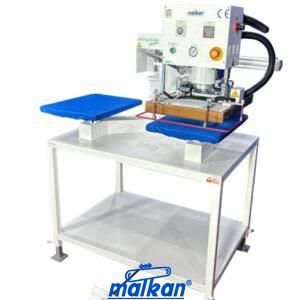
Energy efficient heat transfer press and sustainable manufacturing technologies.
In the factories of the future, the carbon footprint is a metric as important as production speed. A heat transfer press naturally consumes significant energy to generate high heat. However, Malkan engineering utilizes superior insulation techniques and smart element management to minimize this consumption. Specialized insulation materials that reduce heat loss by 20% serve both to lower operational costs and fulfill eco-friendly production goals.
Our efficiency-oriented technical details include:
Aerodynamic plate designs that minimize heat leakage to the environment. Electronic circuit structures that balance reactive power consumption. Rapid-heating technology to shorten standby and startup intervals. Long-lasting Teflon coatings for easier cleaning and maintenance.
These approaches facilitate a modern enterprise’s alignment with the Industry 4.0 vision. Green production is a strategy today, but it will be a legal necessity tomorrow. Businesses that are prepared for this transformation with an energy-efficient heat transfer press will maintain their competitive edge in the global market.
6. Professional Selection Guide: Investment Criteria from an Engineering View
Choosing the right heat transfer press confirms an enterprise’s operational success for the next 5 to 10 years. Before investing, one must look beyond the technical specifications table and scrutinize the engineering power behind the device. A low-cost investment often results in high-cost maintenance and production downtime in the long run.
Critical parameters to consider during the selection process:
Plate Parallelism: A printing table measured with micron-level precision. Heat Distribution Profile: Temperature variance across the plate must be <±2°C. Pressure Mechanism: A heavy-duty steel construction that does not suffer from fatigue. Service Network: The advantage of direct manufacturer support and technical expertise.
Malkan’s corporate services manage the entire process, from pre-sales capacity analysis to post-sales operator training. This holistic service model ensures the efficiency of systems that can integrate with vacuum technology and other finishing equipment.
7. Conclusion: Meet the Technology of the Future Today

Malkan heat transfer press for digital transformation and industrial printing technologies.
The way to survive in the digitalizing global market is to transform production tools into technological assets. A heat transfer press is not just a mass of heated metal; it is an engineering marvel that seals the quality of your brand onto the fabric. Every machine produced in our ISO 9001:2015 certified facilities is a product of this vision and passion for quality.
If you aim to ensure standardization, reduce waste rates, and transition to Industry 4.0 norms, you must work with the right technology partner. Malkan continues to be your strongest ally by combining deep-rooted experience with the digital world of tomorrow.
8. FREQUENTLY ASKED QUESTIONS (FAQ)
How can I choose the most suitable heat transfer press model for my business? The selection process depends on your daily production volume, the maximum dimensions of your printing surface, and the substrate material (textile, metal, ceramic, etc.). For high-capacity operations, pneumatic (air-assisted) models are recommended, while high-precision manual models are ideal for boutique ateliers.
Why is the ISO 9001:2015 certification critical for a heat transfer press? This certification proves that the heat transfer press unit has been manufactured according to international quality standards from design to final assembly. For the user, this translates to fewer breakdowns, higher safety levels, and world-class printing quality.
How is Industry 4.0 integration achieved in your machines? Our new generation systems are equipped with PLC control units and optional data transfer modules. This allows you to monitor the working performance, energy consumption, and print counts of the heat transfer press in real-time via digital platforms, optimizing your production based on actual data.
The path to success in the digital market lies in using production tools as a technological advantage. A professional heat transfer press is an engineering masterpiece that seals your brand’s quality. You can also follow scientific developments regarding Industry 4.0 and vacuum technology.